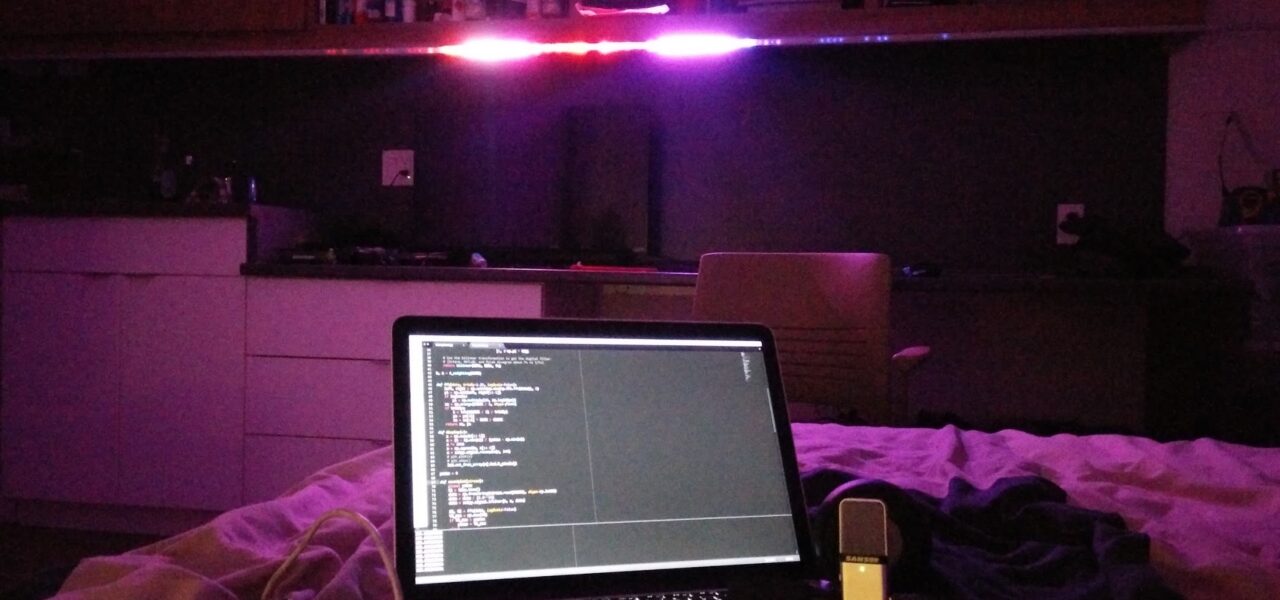
A decade ago, in 2016, a simple idea—to make LED strips pulse with music in real time—turned into a 10-year grind. The result: a GitHub repo with 2.8k stars, Hackaday features, and deployments in nightclubs, Alexa setups, and beginner projects. Yet the creator admits it’s still not good enough. This saga exposes why audio-reactive visuals are brutally tough: raw audio hides chaos that demands sharp signal processing. Hobbyists chase flashy demos, but real results hinge on taming noise, human hearing quirks, and hardware limits. It matters because cheap WS2812 strips (under $20/meter) pair with $5 ESP32 boards, yet 90% of clones flop without these fixes.
Volume Detection: Quick Wins, Fast Boredom
Start simple: grab 10-50ms audio chunks via a cheap electret mic ($0.50), low-pass filter to smooth, map amplitude to brightness. Split across RGB channels with different time constants—fast for red (attack), slow for blue (decay), medium for green. Code it in Arduino in hours. Exponential smoothing handles adaptive gain: new_gain = alpha * measured + (1-alpha) * old_gain, with alpha around 0.1-0.3. It fights saturation in loud rooms or dim flickers in quiet ones.
This works on punchy EDM—bass drops light up like clockwork. But try jazz or vocals? Dead. Volume ignores spectrum: a quiet snare roll beats a loud drone. Three channels limit nuance; no rhythm, no highs/lows separation. Non-addressable strips (e.g., basic RGB, $10/5m) cap you here. Implication: 80% of YouTube “music visualizers” stop at this, fooling viewers with phone mics and post-processing. Real-time demands onboard compute.
Upgrade to WS2812B addressables (30 LEDs/m, 60µs/bit timing). Now 144 pixels mean spatial effects: waves from center outward. But mic noise bites—add preamp (LM358 op-amp, gain 100x) and DC blocking. Still, volume-only gets boring after 10 minutes.
Naive FFT: More Data, Same Problems
Next: Fast Fourier Transform. Window 1024-4096 samples at 44.1kHz (23-93ms), FFT via ArduinoFFT or esp-dsp libraries. Yields ~144 bins for 144 LEDs. Map low bins to left LEDs (bass), high to right (treble). Render spectrum bars. It captures more—cymbals sparkle, kicks thump separately.
But pitfalls stack. Spectral leakage smears frequencies without Hann windowing: multiply samples by (0.5 * (1 – cos(2π n / N))). Bin resolution sucks—44.1kHz/4096 = 10.8Hz/bin, blurring close notes. DC offset and 60Hz hum kill it; high-pass filter first.
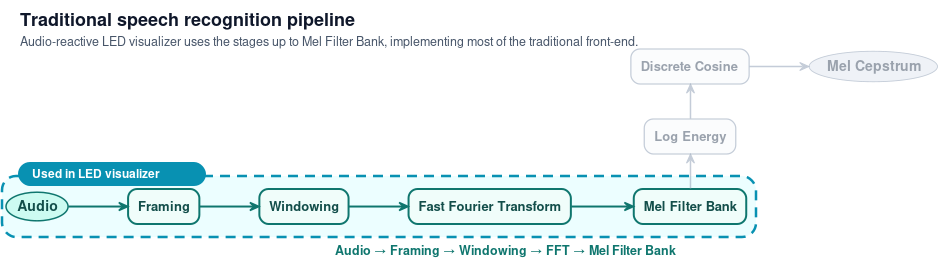
Worse: human ears log-scale frequencies. Linear FFT wastes bins on inaudible highs (>16kHz). Enter mel scale: 2595 * log10(1 + f/700) Hz to mels. Compress to 32-64 mel bands, mimicking cochlea. Libraries like librosa (Python) or custom ESP32 code do this. Pre-2017 prototypes skipped it—flat, unnatural visuals.
Latency creeps: FFT at 50fps needs 20ms compute on 240MHz ESP32, but WS2812 refresh eats cycles. DMA helps, but skips frames under load. Noise floor? Mics pick 20dB junk; RMS average bins, threshold at -40dBFS.
Why It Never Ends: The Real Rabbit Hole
Polish demands beat detection (onset strength via spectral flux), tempo estimation (autocorrelation peaks), even genre adaptation. Integrate IMU for reactive walls. Nightclub deploys? 100m strips (3000 LEDs) strain power (60W/m at full white); use injectors every 5m. Alexa means MQTT over WiFi, sub-50ms latency or lipsync fails.
Hardware traps: WS2812 signal degrades over 10m without level shifters (74HCT245). Cheap strips fake pixels—test with for(i=0;i<num_leds;i++) strip.setPixelColor(i,0xFFFFFF/n);. Software: avoid floats; fixed-point FFT saves 30% CPU.
// Pseudo Arduino FFT snippet
#include <arduinoFFT.h>
arduinoFFT FFT = arduinoFFT();
double vReal[BUFFER_SIZE], vImag[BUFFER_SIZE];
FFT.MajorPeaks(vReal, vImag, BUFFER_SIZE, SAMPLE_FREQ);
Skeptical take: 2.8k stars reflect low bar—most fork and tweak colors, not core DSP. True pros use FPGAs (Xilinx Artix, $100) for 1kHz updates. Why matters? Makers waste weekends on illusions; pros build reliable installs earning $5k/club. Ten years proves: visuals expose audio’s mess. Nail it, and you own the room. Half-ass it, and it’s a dust collector.