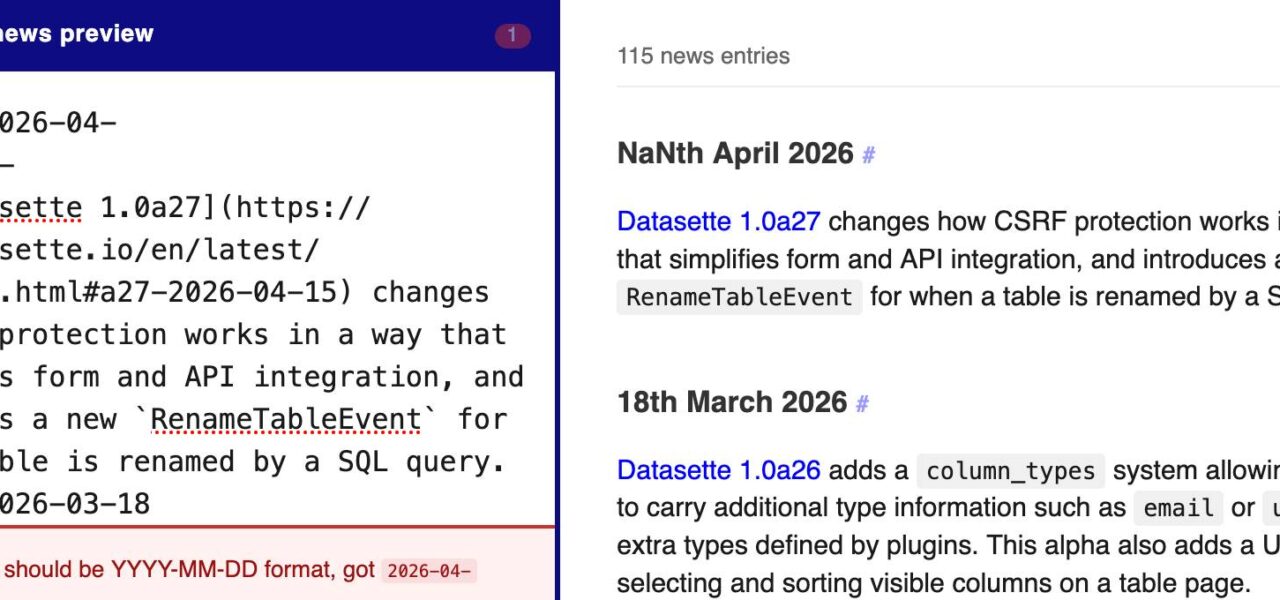
Simon Willison, creator of Datasette, just deployed a custom preview tool for the news section on datasette.io. It parses the news.yaml file from the project’s GitHub repo and renders it live, flagging YAML and Markdown errors on the spot. This tackles a real pain point: editing YAML by hand invites mistakes that only surface after a deploy.
Datasette turns SQLite databases into instant web applications. You point it at a .db file, and it serves a queryable interface over HTTP—complete with faceting, full-text search, and plugin extensibility. Since its launch in 2017, it has processed billions of rows in production setups, from journalism (e.g., LA Times election data) to government transparency portals. Willison maintains it solo, pushing alpha releases weekly. As of now, Datasette 1.0 alphas exceed 27 versions, with the latest (1.0a27 on 2026-04-15) tweaking CSRF protection for easier form/API integration and adding a RenameTableEvent hook.
The Friction in Open-Source Maintenance
The news section on datasette.io pulls directly from news.yaml in the repo. Each entry follows a strict YAML structure:
- date: 2026-04-15
  body: |-
    [Datasette 1.0a27](https://docs.datasette.io/en/latest/changelog.html#a27-2026-04-15) changes how CSRF protection works in a way that simplifies form and API integration, and introduces a new `RenameTableEvent` for when a table is renamed by a SQL query.

- date: 2026-03-18
  body: |-
    ...
Simple, but brittle. Indentation slips, unescaped quotes, or malformed Markdown links break the site. Willison previously edited this raw in GitHub or VS Code, previewing via local deploy—a cycle eating 5-10 minutes per tweak. Multiply by dozens of posts over years, and it compounds.
Enter Claude AI. Willison prompted it to clone the repo, inspect news.yaml and the homepage renderer, then build an interactive artifact. Paste YAML, see rendered output with error highlights. No local setup, no coding. He built it in one chat session using Claude’s GitHub integration and Artifacts feature.
Why This Matters for Devs and AI Tools
This isn’t hype—it’s a practical win. Open-source maintainers like Willison juggle code, docs, and outreach solo. Tools that shave minutes per task scale: he now iterates news faster, catching issues pre-commit. Datasette’s changelog stays crisp, drawing 10,000+ monthly visitors to datasette.io for updates.
Skeptically, AI previews risk hallucinations—Claude might misparse edge-case YAML. But Willison vetted it against real repo data, and for structured content like this (dates, Markdown bodies), it holds up. No vendor lock-in; anyone can replicate the prompt on claude.ai.
Broader implications hit dev workflows. Datasette exemplifies “batteries-included” tools: 200+ plugins, SQLite federation across files. News accuracy ensures users track features like spatial indexes (via SpatiaLite) or async Python support. In a world of bloated frameworks, Datasette clocks sub-100ms queries on 1GB+ DBs without servers.
AI lowers barriers here too. Non-coders paste YAML; pros extend it. Expect copycats: previewers for Hugo frontmatter, Jekyll posts, or static site YAMLs. Cost? Claude’s free tier suffices; Pro at $20/month unlocks repo cloning reliably.
Try it yourself: Hit claude.ai, paste Willison’s prompt verbatim, feed your YAML. For Datasette users, this accelerates onboarding—grab the tool, explore alphas, build on stable 0.66 (Feb 2024). Why care? Friction kills momentum. This kills a sliver of it, proving AI augments humans without replacing repo discipline.