Satellites move at 7.5 km/s relative to ground stations. Passes last 10 minutes. Bandwidth tops out at kilobits per second. Standard protocols must handle this without room for error. Enter CCSDS, the Consultative Committee for Space Data Systems standards suite. Since 1982, NASA, ESA, JAXA, and others have maintained it. Nearly every satellite launched in the last 30 years uses some CCSDS subset. Proprietary C libraries dominate implementations, locked inside ground station software. An independent developer reimplemented key parts in OCaml, with typed binary codecs, to run in browsers. You can now encode telemetry frames client-side, inspect bytes, and simulate satellite transmissions.
This matters because CCSDS forms the backbone of space communications. Ground stations worldwide speak it to downlink science data or uplink commands. Open implementations cut through vendor lock-in. They let engineers, researchers, or hobbyists verify packets without multimillion-dollar setups. The browser demo wraps a user message into a real Space Packet inside a TM Transfer Frame—exactly as a satellite emits. Edit the hex dump, hover bytes to highlight fields like SCID (spacecraft ID, 10 bits), VCID (virtual channel, 3 bits), APID (application process ID, 11 bits), or sequence numbers. No black-box testing needed.
The Protocol Layers
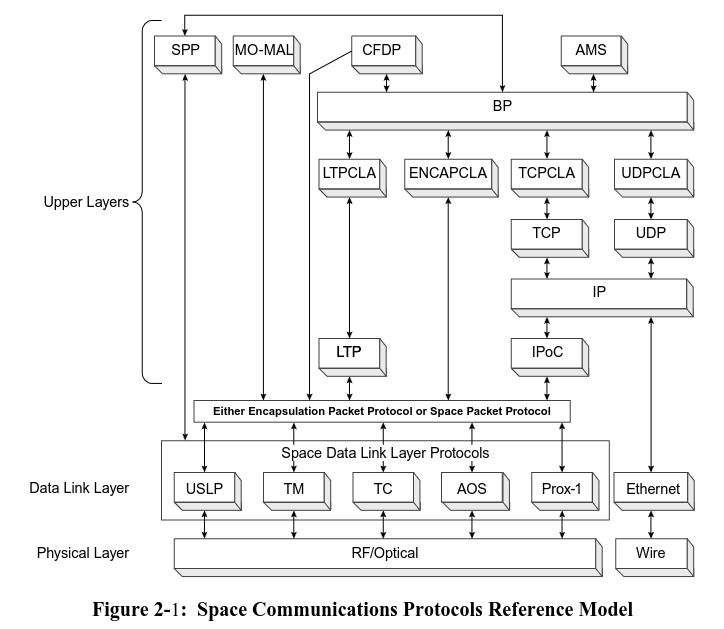
CCSDS mimics TCP/IP but strips complexity for 1990s flight computers: kilobytes of RAM, fixed-point math, no OS. Headers stay tiny, fields fixed, no options or negotiation. Blue Books cover ratified standards like Space Packets (133.0-B-2) and Transfer Frames. Magenta Books handle recommended practices such as delay-tolerant networking. Orange Books explore experiments like post-quantum crypto.
Space Packets sit at the application layer. A 6-byte header flags version (2 bits, almost always 0), APID (11 bits, identifies processes like housekeeping or payloads), sequence flags and count (14 bits for ordering), and data length (up to 65,536 bytes). No checksums, encryption, or retries—lower layers manage those. Simplicity ensures parsing on resource-starved hardware.
Transfer Frames shuttle packets over radio. Telemetry (TM, 132.0-B-3) flows satellite-to-ground: 6-byte header plus Space Packet(s), optional CRC. Telecommands (TC, 232.0-B-4) go the other way, with similar structure but command-specific tweaks. Advanced Orbiting Systems (AOS, 732.0-B-4) add multiplexing for high-rate data. Unidirectional Space Link Protocol (USLP, 732.1-B-2) supports async ops. Frames cap at 1,024 bytes typically, fitting low-power transmitters.
Implementation and Security Angles
The OCaml port uses a codec approach from prior wire format work. Types enforce valid packets at compile time—version must be 0, lengths align. Browser WebAssembly compiles it fast. Paste a message, generate frame, decode layers. This exposes flaws in closed-source tools: misaligned bitfields, ignored CRCs. Skeptical take: proprietary stacks from vendors like KSAT or KServe persist because agencies prioritize certification over openness. But bugs in them have lost missions—recall NASA’s 2003 Mars Climate Orbiter, partly protocol mismatches.
Security lags. Base CCSDS lacks encryption; authentication relies on SCID/VCID secrecy or add-ons like CCSDS Space Link Security (Orange Book drafts). Post-quantum efforts target lattice-based keys for quantum threats to elliptic curves. Why care? CubeSats from universities or startups flood orbit—over 7,000 active satellites per UCSAT database. Amateurs track them via SDRs like RTL-SDR. An open stack democratizes access but risks abuse: spoofed commands could brick a bird. Agencies mitigate with frequency hopping and directional antennas, but low-Earth orbit densifies fast with Starlink’s 6,000+ birds.
Broader implications hit NewSpace. SpaceX’s Starlink tweaks CCSDS for laser links, but ground segments stick close. Reimplementations like this enable protocol fuzzing, anomaly detection. Finance angle: satcom markets hit $10B yearly (NSR reports), with ground stations as bottlenecks. Open tools lower barriers for insurers verifying payloads or traders leasing bandwidth. Test it yourself—fork the repo, run locally. In space, where bits cost thousands per, reliability trumps hype. This stack delivers.