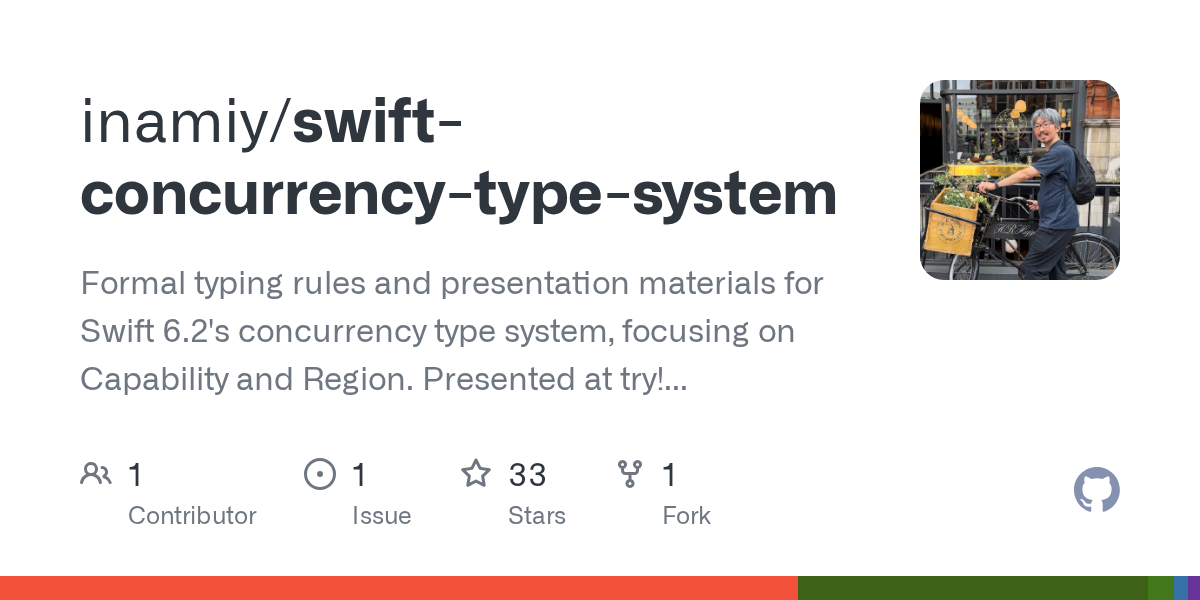
Swift 6.2 introduces a formalized concurrency type system centered on Capabilities—defining where code executes—and Regions—specifying where data resides. Developers Kazunobu Inamiy presented this at try! Swift Tokyo 2026, releasing slides, a paper, and typing rules that dissect the mechanics. Watch the video at youtu.be/Vs_hytYk3HU, or view HTML slides at inamiy.github.io/swift-concurrency-type-system/slide.html and PDF at speakerdeck.com/inamiy/swift-concurrency-type-system.
This matters because Swift’s concurrency model, built on actors since 5.5, now enforces data-race freedom at compile time in Swift 6. The new system refines isolation with regions, enabling finer-grained control over data access in concurrent code. Without it, developers risk subtle races in high-performance apps like games or servers. The formal rules prove soundness, but they demand steep learning—expect friction for teams upgrading legacy codebases.
Core Typing Judgment and Mechanics
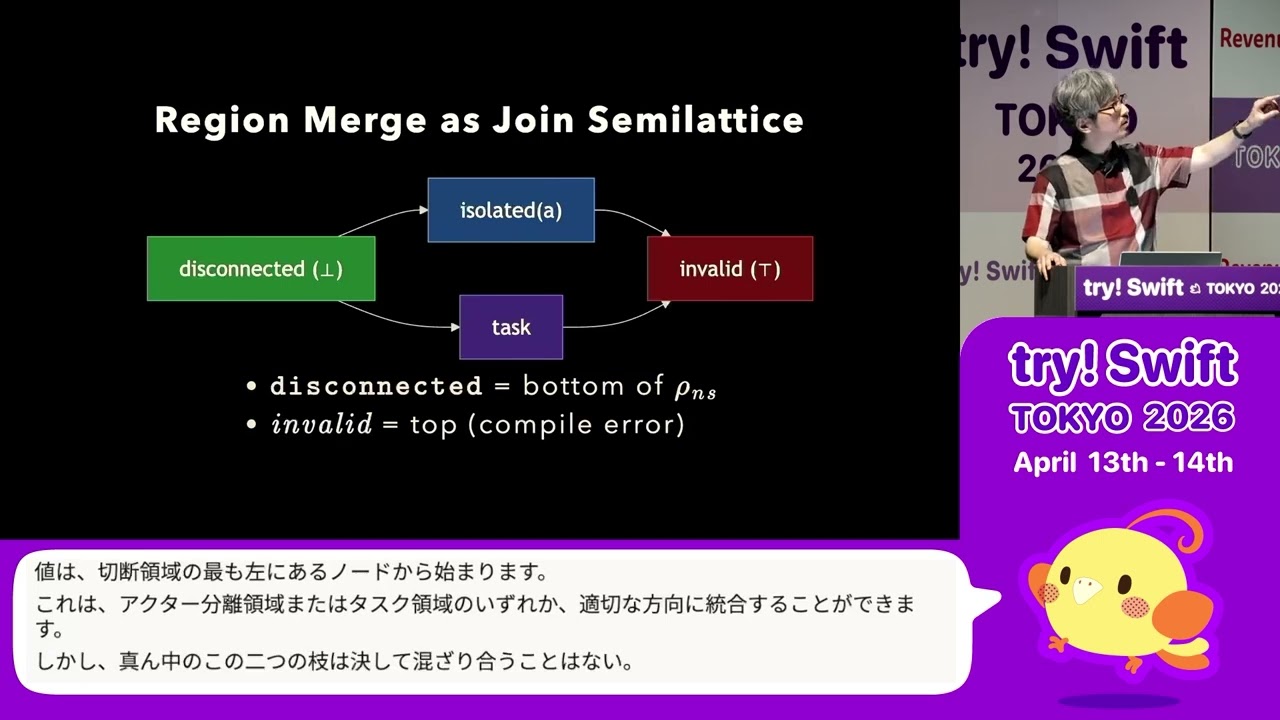
The system’s heart is the judgment form: Γ; @κ; α ⊢ e : T at ρ ⊣ Γ'. Here, Γ tracks context, @κ is the capability (e.g., @nonisolated for global access or @MainActor for UI threads), α handles affine types, e : T types the expression, ρ pins data to a region (like disconnected for locals, isolated(a) for actor-bound, or task for tasks), and Γ' updates the context.
Affine discipline ensures resources like regions aren’t duplicated: merges refine permissions (broadening access), transfers shrink them (e.g., sending as affine move). This covers function conversions, closure isolation inference, and safe sends across actors. Skeptically, it’s elegant on paper—rooted in typed lambda calculus—but real-world SIL (Swift Intermediate Language) emissions will test if compilers enforce it without perf hits. Check paired Swift/SIL examples in the repo’s swift-sil/ for dumps.
Backed by Swift Evolution Proposals: SE-0414 (region-based isolation), SE-0430 (sending params/results), SE-0431 (@isolated(any) types), SE-0461 (nonisolated nonsending default). These land in Swift 6.2, tightening what Swift 6 started with whole-program checks.
Resources and Hands-On Exploration
Grab beginner guides first: Japanese original at docs/beginner-guide-ja.md, English at docs/beginner-guide-en.md. They ease into lambda calculus notation without drowning you. Typing rules—the source of truth—are in Japanese (docs/typing-rules-ja.md) with synced English (docs/typing-rules-en.md). Mermaid diagrams visualize conversions; scripts in docs/scripts/ generate them.
Project splits into docs, SwiftPM package (swift/ with concurrency-type-check for experiments in Swift 6 mode), SIL analysis, Marp slides, ACM-formatted paper, and read-only Swift/swift-evolution submodules.
Build it:
make setup  # npm deps, Mermaid diagrams
make -C slide html  # HTML slides
make -C slide pdf   # PDF slides
make -C paper pdf   # LaTeX paper via tectonic
Implications cut deep for iOS/macOS devs: regions unlock ergonomic patterns like task-local storage without actor hops, slashing boilerplate. But complexity rises—@isolated(any) blurs lines, risking misuse. Security angle: compile-time checks block races that attackers exploit in networked apps. Finance/crypto apps, with their async APIs and ledgers, gain reliability. Fair take: proofs are gold, but tooling (IDEs, error messages) must evolve or adoption stalls. Fork the repo, type-check your actors, and see if Swift 6.2 delivers race-free concurrency at scale.