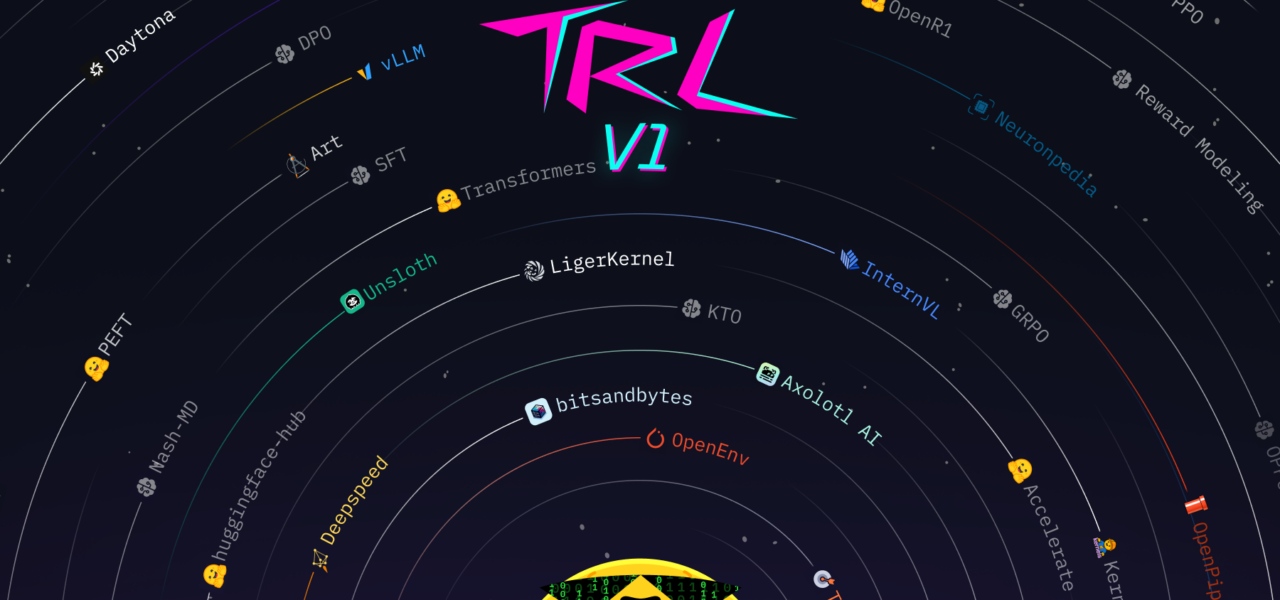
TRL v1.0 just dropped from Hugging Face. This library, now over six years old with its first commit in 2018, implements more than 75 post-training methods for large language models. Developers use it to align models via techniques like RLHF, DPO, and newer verifier-based approaches. The v1.0 tag signals stability: no more breaking changes in core APIs. Production teams can now build on it without fearing weekly rewrites.
Post-training isn’t a settled science. It shifts every 12-18 months, invalidating yesterday’s best practices. Early on, PPO dominated. Introduced in 2017 by Schulman et al., it powered OpenAI’s InstructGPT in 2022: train a reward model on human preferences, then optimize policy against it using rollouts and KL divergence penalties. Libraries locked into this stack—policy nets, reference models, PPO loops—worked fine until DPO arrived in 2023.
The Paradigm Shifts That Broke Everything
Rafailov et al.’s Direct Preference Optimization skipped the reward model entirely. It reformulates RLHF as a classification loss on preference pairs, slashing compute by 50-80% in benchmarks. ORPO (Hong et al., 2024) and KTO (Ethayarajh et al., 2024) followed, embedding safety directly into the loss without online sampling. PPO’s “canonical” stack—once 500+ lines of boilerplate—shrank to 50. Libraries betting on reward models looked obsolete overnight.
Then came RLVR-style methods like GRPO (Shao et al., 2024). For math, code, and tool-use tasks, rewards come from verifiers—think code executors or math solvers—not fuzzy human labels. Sampling returns, but now looped with process supervision or outcome checks. PPO-era tools choke here: no built-in verifier hooks, mismatched data flows. The field redefined “post-training” thrice in three years. No library survived unchanged.
TRL adapted because it had to. Over 75 methods means it covers PPO, REINFORCE, DPO, IPO, KTO, SimPO, GRPO, and odds like RAFT or Dr. Edit. But breadth alone doesn’t cut it. The real win is modularity: swap reward functions, losses, or samplers without refactoring. First-time users train DPO on Zephyr-7B in under an hour; pros chain GRPO with tools for agent fine-tuning.
Why Stability Matters in Chaos
AI labs burn millions iterating alignments. A brittle library multiplies that: rewrite trainers, debug data pipelines, chase API drifts. TRL v1.0 freezes the core—Trainer classes, SFTTrainer, DPOTrainer—while accelerators handle experiments. GitHub stars hit 10k+, with 500+ contributors. It’s battle-tested on Llama-3, Mistral, and Qwen models up to 70B params.
Skeptical take: Is v1.0 truly future-proof? The field moves fast—expect diffusion-based rewards or test-time training next. TRL’s “chaos-adaptive” design leans on composable primitives, not rigid abstractions. Unusual at first (e.g., no unified “RL loop”—pick your poison), but it mirrors reality. Compare to TRL’s rivals: Stable Baselines3 stalls on LLMs; RLlib scales but overwhelms for 7B models. TRL hits the sweet spot.
Implications run deep. Open-source teams democratize alignment: solo devs match Meta’s Llama Guard quality. Enterprises plug it into pipelines for custom agents—finance chatbots rejecting trades, code-gen passing unit tests. Costs drop: DPO on A100s finishes in days, not weeks. But watch the gotchas—overfitting on synthetic prefs, verifier brittleness. TRL exposes them; users must harden.
Bottom line: TRL v1.0 doesn’t predict the future. It survives it. Grab it from pip install trl, fork the repo at huggingface/trl. In a field eating its young, this library endures.