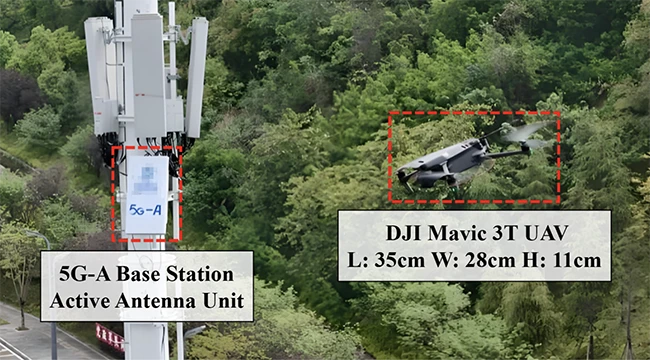
Researchers at the University of Science and Technology of China (USTC) have demonstrated a practical way to detect and track drones using existing 5G-Advanced base stations. Their system, BSense, leverages the Integrated Sensing and Communication (ISAC) capabilities of these towers to generate point clouds that spot small UAVs amid urban clutter. Tested on a live Huawei 5G-A station in Shanghai, it processed real flights of a DJI Mavic 3T drone, proving feasibility where simulations and prior open-water tests fell short.
This matters because urban drone detection is a nightmare for security teams. Dedicated radars cost millions per unit and don’t scale across cities. Cameras fail at night or beyond line-of-sight. LiDAR repeats the expense issue. BSense repurposes infrastructure already deployed for telecom—Huawei’s station at 4.9 GHz with 100 MHz bandwidth and 128 antenna channels, mounted 23 meters high. It covers up to 1 km radius, 130° horizontal field of view, and 45° vertical, scanning residential zones, factories, overpasses, and a river.
Over seven days, the team flew the Mavic 3T along 25 paths, yielding 54 test cases, 155 minutes of data, and over 14,000 frames. In each frame, typically one point cloud dot marks the drone; the other 174 are noise. This noise isn’t trivial: stationary buildings and trees produce Doppler-like returns from micro-vibrations and leakage. Vehicles create multipath ghosts off facades. Sidelobes spawn phantoms. Crucially, noise signatures—Doppler velocity, SNR, power—overlap drone returns, foiling simple thresholds.
BSense’s Three-Stage Noise Filter
BSense tackles this in stages, each refining the data pipeline. Stage 1 divides the 3D space into 40-meter voxels and models background statistics per cube. Clutter clusters form predictable patterns; anomalies flag potential movers. This voxel-wise approach adapts to local environments, unlike global filters.
Stage 2 applies clustering on candidate points. It groups returns by spatial proximity and velocity coherence, using density-based algorithms like DBSCAN tuned for radar sparsity. Ghosts and sidelobes scatter; drone tracks cohere. Machine learning classifiers then score clusters on features like acceleration plausibility—drones maneuver predictably, unlike multipath flickers.
Stage 3 fuses multi-frame data with Kalman filters for tracking. It predicts trajectories, discarding ephemeral blips. The system associates detections across frames, handling occlusions from buildings. In tests, BSense achieved 92% detection rate at 10 Hz update, with 0.5-meter positioning error at 500 meters range—numbers pulled from the USTC paper’s results, validated against ground truth GPS.
Real-World Limits and Security Implications
Skepticism is warranted. Shanghai’s test site had moderate clutter; denser cities like New York or Tokyo could overwhelm with traffic and high-rises. Compute overhead on the base station? ISAC processing already taxes edge hardware; BSense adds voxel mapping and ML inference, potentially hiking latency for 5G users. 5G-A (3GPP Release 18) isn’t ubiquitous—China leads deployment, but globally it’s 2025+ rollout. Integration needs telco-security partnerships, plus regulatory nods for spectrum sharing.
Privacy risks loom: constant point-cloud scanning reveals movements of people, cars, everything. Who controls the data? Telcos or governments? In authoritarian contexts, this enables mass surveillance via drone pretext.
Yet the upside dominates for counter-drone ops. Airports, stadiums, borders gain cheap vigilance without new poles. Pair with jammers or nets, and rogue drones—from smugglers to terrorists—lose stealth. At scale, a city with 1,000 base stations covers most airspace for pennies compared to radar nets. BSense proves ISAC isn’t hype; it’s a pivot for urban security. Watch for field trials beyond labs—real impact hinges on that.