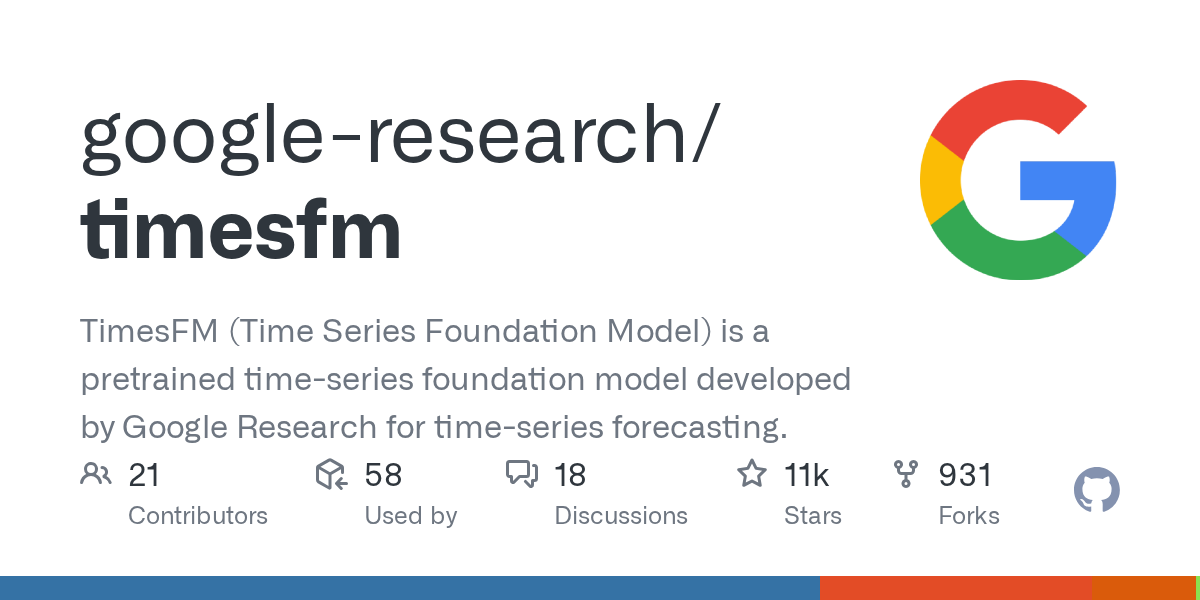
Google just open-sourced TimesFM, a 200 million parameter foundation model built specifically for time-series forecasting. It handles up to 16,000 timesteps of context—roughly 512 hours at hourly resolution or over two years at daily intervals. Trained on 100 billion real-world observations from 100 million time series, it delivers zero-shot probabilistic forecasts without any fine-tuning on your data.
This isn’t hype. Google Research published the details in a June 2024 paper, and they released the model weights on Hugging Face. At 200M params, it’s compact—runs inference on a single GPU in seconds for long horizons. Traditional methods like ARIMA or Prophet demand per-series training and struggle with multivariate data or irregularities. TimesFM, a decoder-only transformer with patching (similar to vision transformers), ingests raw time series and spits out forecasts plus uncertainty estimates.
How It Stacks Up
Benchmarks tell the story. On the Monash benchmark suite—covering 21 datasets from economics, energy, traffic, and more—TimesFM beats specialized deep learning models like N-BEATS and PatchTST by 4-20% in mean weighted scaled interval score (MWSIS), a metric balancing accuracy and calibration. It outperforms even large fine-tuned LLMs like GPT-4 on some tasks.
Key edge: zero-shot performance. You feed it a new series with 512-step context, specify forecast horizon up to 512 steps (extendable probabilistically), and get results. For multivariate forecasting (up to 128 channels), it captures cross-variable dependencies natively. Inference scales linearly with context length, but at 16k, it’s practical for most use cases.
Table stakes include handling missing values, seasonality, trends, and irregularities out of the box. Pretraining on diverse public and synthetic data (e.g., electricity, traffic, finance) gives it broad generalization. Skeptical take: Monash is curated; real-world data often has domain shifts, outliers, or proprietary quirks. Google’s dataset skews toward hourly/daily frequencies—ultra-high-res like seconds might need adaptation.
Why This Matters for Tech, Finance, and Beyond
Time-series forecasting powers $10B+ markets in supply chain (demand planning), finance (volatility, returns), energy (load balancing), and anomaly detection. Companies burn millions tuning models per asset. TimesFM slashes that: plug-and-play reduces dev time from weeks to hours. In crypto, where 24/7 high-freq data reigns, 16k context covers days of tick data—vital for risk models or arb strategies.
Finance angle: Banks and hedge funds rely on GARCH or LSTMs for volatility; TimesFM’s probabilistic outputs could integrate into VaR calculations faster. Security ops? Network traffic forecasting spots DDoS early. But fair warning—foundation models aren’t magic. They underperform on very short series (<100 points) or pure noise. Always validate on holdout data.
Broader implications hit AI efficiency. LLMs guzzle billions of params for text; TimesFM proves 200M suffices for structured data like TS, hinting at leaner architectures elsewhere. Open-sourcing democratizes access—indies and startups compete with Big Tech. Expect forks: quant funds fine-tuning on order book data, e-com tuning for inventory.
Access it via Hugging Face Transformers:
from transformers import TimesFMForConditionalGeneration, AutoProcessor
model = TimesFMForConditionalGeneration.from_pretrained("google/timesfm-200m-pytorch", device_map="auto")
processor = AutoProcessor.from_pretrained("google/timesfm-200m-pytorch")
# Example inference here
Bottom line: TimesFM isn’t revolutionary yet, but it sets a benchmark. If it holds in production, expect time-series AI to mirror NLP’s shift—foundation models everywhere, fine-tuning rare. Watch for competitors like Nixtla’s Lag-Llama or Amazon’s Chronos. For now, test it yourself; the proof is in your data.