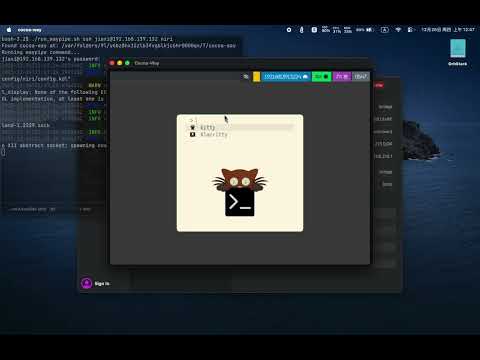
Cocoa-Way delivers a native macOS Wayland compositor built in Rust with Smithay. It pipes Linux Wayland apps directly to your Mac’s display via Unix sockets, skipping virtualization overhead. Developers tested it rendering Firefox from an OrbStack Linux container with smooth Metal/OpenGL acceleration and Retina scaling. This matters because it slashes latency for GUI Linux apps on macOS—think no more sluggish X11 forwarding or full-screen VNC hacks.
The core trick: Wayland protocol travels over SSH or sockets using waypipe-darwin. A Linux app connects to waypipe server, which tunnels to waypipe client on macOS, then feeds into Cocoa-Way for compositing. No VM needed, just a socket. Result? Native windows with shadows, focus highlights, and hardware acceleration. HiDPI handles fractional scaling properly, unlike XQuartz’s pixelation.
Setup and Real-World Use
Installation is straightforward via Homebrew: tap J-x-Z/tap, then brew install cocoa-way waypipe-darwin. Launch with cocoa-way. Connect apps via the provided script:
./run_waypipe.sh ssh user@linux-host firefoxThis auto-cleans stale sockets with -o StreamLocalBindUnlink=yes. Tested on OrbStack, it pulls apps like Firefox seamlessly. Building from source requires libxkbcommon, pixman, and Cargo—git clone https://github.com/J-x-Z/cocoa-way.git; cd cocoa-way; cargo build --release.
Why care? Mac users running Linux tools (e.g., via OrbStack or remote SSH) get desktop-like integration without XQuartz’s high latency or VM GUIs’ complexity. Benchmarks aren’t public, but the demo shows fluid 60fps rendering, beating VNC’s compression lag.
Beats Alternatives, But Not Perfect
Compare solutions:
| Solution | Latency | HiDPI | Native Integration | Setup |
|---|---|---|---|---|
| Cocoa-Way | Low | ✅ | ✅ Native windows | Easy |
| XQuartz | High | ⚠️ | Partial (X11 quirks) | Medium |
| VNC | High | ❌ | Full screen | Medium |
| VM GUI | High | ⚠️ | Partial | Complex |
Cocoa-Way wins on speed and polish. XQuartz drags with X11’s single-threaded rendering; VNC chews bandwidth. But it’s SSH-bound now—no local containers without waypipe tweaks. Multi-monitor? Planned. Clipboard sync? Roadmap. GPL-3.0 license invites contributions, but it’s early—Windows (win-way) and Android backends are WIP.
Skeptical take: True zero-overhead? Waypipe adds minimal proxy latency, but SSH encryption bites remote use. Local sockets shine. Part of “Turbo-Charged Protocol Virtualization” research, it leverages Rust’s monomorphization and SIMD for pixel ops. Implications for cross-platform: If roadmap delivers, devs ditch VMs for lightweight Linux GUIs on any OS. Watch the GitHub repo—issues welcome, but discuss changes first.
Bottom line: Cocoa-Way bridges macOS and Wayland ecosystems efficiently. For Rust fans or Mac/Linux hybrid workflows, it’s a low-risk install. Test it; the demo video proves the hype-free gains.